Some romantics believe everyone has a soulmate. I’m not sure if that’s true in love, but I think it is very much true in bjj. You know the feeling. It’s that moment when you engage in an effortless roll…when you slap hands and smile, knowing that it’s going to be a fun roll…when you transition from position to position with little resistance, but with the mutual agreement on the intensity of the transitions, technique, and overall movement…it’s when the time is called, and you both slap hands and hug in relief because you both experienced an incredibly gratifying roll while each improving on some aspect of the game. Some may think it’s coincidental, but I like to call it a match with my jiu-jitsu soulmate.
Some of these training relationships come naturally, but sometimes, it is more of a challenge. Over the past 3 years, I have struggled in finding the right balance with some of my training partners. I’m not going to lie. When I first started training, there was a lot of finger-pointing when things didn’t go my way in training. “He’s going too hard with me. He’s overcompensating with strength. That person hogged the entire roll. I didn’t get to try anything.” Even to this day, I find myself having those mental thoughts, but in reality–I need to tell myself that there is not or should not be any ill-will against my training partners. We all just want to get better, and it’s not always your training partner’s fault. It could very well be your fault, or the fault of you both. In the end, there is a lesson to learn in order to make this work–whether a lesson in bjj or in your own personal weaknesses.
On Saturday, I rolled with my teammate who we will call “Russell.”
I used to get so frustrated rolling with Russell. He started training about 6 months after me. He was 15, and I was 31 at the time. He was about 6′ tall; I was (still am) 4’11”. Russell was about 200 lbs; I was 115-120. We were both white belts. I was a stressed out and high-strung attorney working 65-80 hours a week, and Russell was a sophomore in high school with a pastime of playing video games. We had nothing in common.
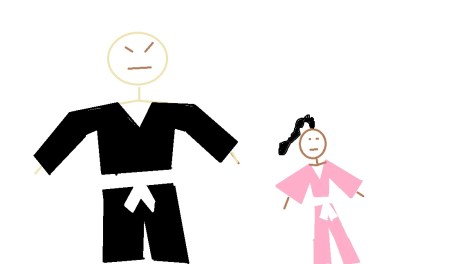
A slight exaggeration, but this was Russell and me.
I would get slammed, smashed, and tossed around during our rolls. I would always blame our rough sparring on him and could see little fault in myself. I would do my best to survive, but often felt that he would go too hard or use his strength against me rather than technique. It was incredibly demoralizing, and I also found it difficult to connect with him off of the mats considering our age gap and dissimilarity in interests. I saw him as a little kid, and he refused to speak to me as an adult who was twice his age. It was ugly.
We stopped sparring together for over year, and this is what I have learned:
1) I need to be more patient.
2) I need to communicate my issues with my training partners.
3) I need to stop being selfish.
4) Before blaming others, I need to ask myself, “Is there something that I need to improve about myself?”
5) If I do not constantly self-assess, I will run out of training partners.
Russell and I each went through our own journey during this time apart. We worked on different techniques. We helped different newcomers who joined the gym since we had become more seasoned. We each took different paths in our competitions and supported each other at a distance. Recently, we have been paired together, and something has clicked for the both of us. We were both adequately challenged. I worked on my guard retention while he worked on his leg drags and movement. We put each other in compromising positions, but somehow found a balance in the intensity of our rolls and transitions. During Saturday’s roll, we had that moment when we slapped hands and hugged in relief because we both experienced that incredibly gratifying roll. After 2 years and individual challenges in our own games and progression of bjj, I can now proudly say that Russell has become one of my jiu-jitsu soulmates. It is one of the greatest feelings, and I’m ready to search for more jiu-jitsu soulmates.
 i am brendadee